LANDING PAGE
FOUNDATIONS
Build a Simple Page That Gives Visitors One Clear Next Step
Learn how to plan and build a simple landing page without complicated technology, aggressive sales tactics, or unrealistic income promises.
Welcome to the MMO Essentials Foundations Library
Every online business is built on foundations.
Unfortunately, many people are encouraged to chase shortcuts before they understand the basics.
At MMO Essentials, we believe in Clarity Before Complexity.
Each Foundation Workbook focuses on one practical skill you can understand, apply, and build upon.
"Build the Foundation. The Rest Will Follow".
Inside This Workbook
Opening Note
Who This Workbook Is For
What This Workbook Is Not
What Is a Landing Page?
Common Page Types
Why Landing Pages Matter
The CLEAR PAGE Method
Common Landing Page Mistakes
Reader Toolkit
Landing Page FAQ
7-Day Build Plan
MMO Essentials Build Log
Continue Your Journey
About MMO Essentials
Opening Note
Landing pages are often made to sound far more complicated than they need to be.
You may have heard that you need the perfect headline, expensive software, advanced copywriting, countdown timers, videos, testimonials and special tricks before anyone will take action.
You may also have built or imported pages like that already. Perhaps the template looked impressive, the software promised everything was ready, or the copy came with a done-for-you system—but you still could not clearly explain who the page was for or what the visitor should do next.
That experience is not wasted. It has probably shown you that more sections, buttons, and features do not automatically create more clarity.
Before long, your simple landing page has six buttons, three countdown timers, and no idea what it wants the visitor to do.
That is not what we are doing here.
A landing page has one main job.
It helps the right person understand:
What you are offering
Why it may be useful
What they should do next
What will happen after they act
This guide will help you plan, build, check, and improve one clear landing page.
You do not need to master funnels.
You do not need complicated technology.
You do not need aggressive sales tactics.
You need one clear page with one clear purpose.
CORE PURPOSE
A landing page should help one person understand one useful offer and take one clear next step.
You do not need the loudest page. You need a page that makes sense.
Who This Workbook Is For
This workbook may help you if:
You want to build a simple landing page without getting buried in technical terms.
You want to grow an email list or give people one clear next step.
You have created a lead magnet but do not yet have a clear sign-up page.
You feel confused by landing pages, squeeze pages, bridge pages, and funnels.
You have imported templates or done-for-you pages but still cannot explain why each section is there.
You have used page-building software that made the design easier but did not make the message clearer.
You have pages with several buttons, links, or offers competing for attention.
You have changed layouts, colours, or headlines repeatedly without knowing whether the real problem was the audience, offer, promise, or next step.
You are tired of aggressive sales tactics and unrealistic promises.
You want AI to assist with planning and first drafts without replacing your judgment.
You have limited time and need one practical process you can follow.
You may be building a landing page for the first time. You may also be reviewing a page that looked complete but never became clear, connected, or easy to trust. Either way, you are not starting from nothing.
What This Workbook Is Not
This is not a promise of instant leads.
This is not a guaranteed sign-up formula.
This is not a complete funnel-building course.
This is not an advanced copywriting programme, web-design masterclass, coding tutorial, or paid-traffic strategy.
This is not a guide to pressure tactics, secret tricks, fake urgency, or claims that one page will create automatic income.
This is not a push-button AI page generator.
You may already have templates, saved copy, live pages, page-builder accounts, or parts of a done-for-you funnel. You do not need to delete everything or start again automatically. The goal is to review what each piece is doing, keep what supports the page’s purpose, and remove what creates confusion.
This workbook focuses on planning, building—or rebuilding—connecting, and improving one clear landing page.
What Is a Landing Page?
SIMPLE DEFINITION
A landing page is a focused web page created to help someone take one main action.
That action might be:
Joining an email list
Downloading a free resource
Registering for something
Starting a free trial
Requesting more information
Buying a product
Moving to another page
A normal website page may include menus, several topics, different links and several calls to action.
A landing page is more focused. It is usually built around:
One person
One offer
One message
One next step
A SIMPLE SHIFT
Do not think of a landing page as a trap designed to stop people leaving.
Think of it as a clear path. The visitor should understand where the path leads and decide whether it is right for them.
Common Page Types
Opt-In Page
A page that invites someone to join an email list, usually in exchange for a useful resource.
Lead Capture Page
Another common name for a page designed to collect contact details.
Squeeze Page
A short, focused opt-in page with very few distractions. The name can sound aggressive, but the useful idea is simply focus.
Bridge Page
A page placed between the visitor and another destination. It may explain a recommendation or prepare the visitor for the next step.
Sales Page
A page designed to explain and sell a paid product or service.
Thank-You Page
The page shown after someone submits a form or completes an action. It confirms what happened and explains what comes next.
FOUNDATION REALITY CHECK
You do not need to memorise every page name before you begin.
Start with the job the page needs to do. The label can come afterwards.
Why Landing Pages Matter
People may discover you through:
A blog post
A YouTube video
A search result
A social post
A recommendation
An affiliate review
A free resource
A landing page gives them somewhere useful to go next.
Without one, they may read, watch, or click and then disappear.
A useful landing page can help you:
Grow an email list
Offer a lead magnet
Support a blog post or video
Explain a resource
Recommend a tool clearly
Create the first page of a future funnel
Build something you can test and improve
MMO ESSENTIALS INSIGHT
A landing page does not create trust by itself. It gives your message, content or offer a clear place to continue.
The CLEAR PAGE Method
The CLEAR PAGE Method helps you move from idea to published page without making the process more complicated than it needs to be. It breaks the process into 9 clear stages so you can focus on the right decision at the right time without overcomplicating the work.
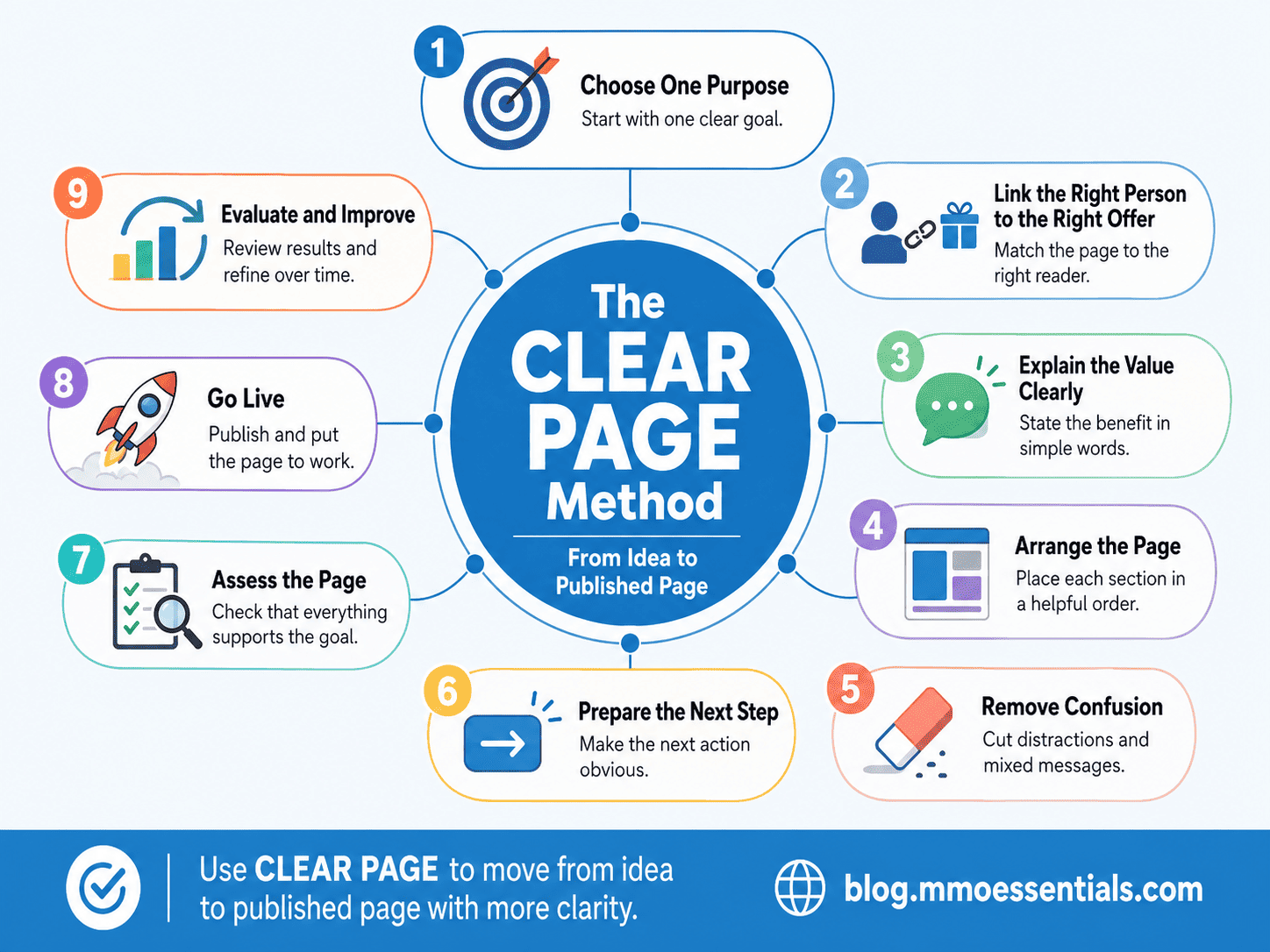
The CLEAR PAGE Method can help you build a new page or review one you already have.
If your page is already live, do not begin by changing the template. Work through the method in order and check the purpose, person, offer, message, layout, next step, and full path first.
A polished page with an unclear job does not need more decoration. It needs a clearer decision.
THE CLEAR PAGE MAP
Purpose → Person → Offer → Message → Page → Next Step → Check → Publish → Improve
C — Choose One Purpose
Decide the one main action you want the visitor to take.
Do not begin with the template, colours or button style.
Start with the job the page needs to do.
FOUNDATION BUILDER
Complete this sentence:
This landing page will help someone ______________________________.
The visitor will _______________________________________________.
L — Link the Right Person to the Right Offer
Make sure the page is for the same person the offer is meant to help.
A broad message often creates weak recognition.
A clear message helps the right person think, 'This is for someone in my situation.'
A SIMPLE SHIFT
Do not ask, 'How can I make this irresistible to everyone?'
Ask, 'How can I make this relevant to the right person?'
E — Explain the Value Clearly
Tell the visitor what they will receive and how it may help.
Avoid vague phrases such as 'unlock your potential.'
Use plain words that describe the real benefit.
CLARITY CHECK
Can someone understand the offer without knowing your product name or marketing terms?
A — Arrange the Page
Put the information in an order that answers the visitor's questions.
What is this? Is it for me? What do I get? What do I do next?
MMO ESSENTIALS OPINION
The page should follow the visitor's questions, not the order the template happens to use.
R — Remove Confusion
Take away anything that competes with the main message.
Remove unrelated buttons, repeated claims, unnecessary sections and technical jargon.
If you are reviewing an existing page, make a quick list of every element before changing anything:
✅ each headline
✅ each button
✅ each link
✅ each form
✅ each image
✅ each testimonial
✅ each timer
✅ each offer
✅ each promised next step
Then ask what job each element performs.
If two buttons lead to different actions, decide which one supports the page’s main purpose.
If a section exists only because the template included it, make it earn its place.
If you cannot verify a claim, testimonial, result, or urgency message, remove it.
The aim is not to make the page shorter for the sake of it. The aim is to remove anything that competes with the decision you want the visitor to make.
Keep any privacy, legal or contact information that is genuinely needed.
REMEMBER
Focus removes confusion. Pressure removes choice. They are not the same thing.
P — Prepare the Next Step
Make sure the button, form, thank-you page and delivery all work.
The button is not the finish line. It passes the visitor to the next step.
A — Assess the Page
Read it as though you have never seen it before.
Test every link and form.
Check the real page on your phone.
G — Go Live
Publish the clear first version.
A private draft cannot give you useful feedback.
Your first version should be clear, honest, functional and easy to use.
FIRST-VERSION STANDARD
Clear. Accurate. Honest. Functional. Mobile-friendly. Connected.
E — Evaluate and Improve
See what happens and make one useful change at a time.
Do not change the headline, offer, layout, image, button and form all at once.
Start with the biggest clarity problem.
CLARITY CHECK
Can someone understand the offer without knowing your product name or marketing terms?
Writing the Core Message
Write a Clear Headline
Your headline has one important job: help the right person understand what the page offers and why it may be useful.
It does not need to shout. It needs to be clear.
Useful headline patterns include:
Build [something useful] without [main obstacle].
Get the [resource] that helps you [result].
Learn how to [task] without [obstacle].
[Clear result] with a simple [resource or process].
Examples:
Build Your First Landing Page Without Tech Overwhelm
Get the Checklist That Helps You Plan Your First Opt-In Page
Learn How to Create a Simple Landing Page
Give Every Visitor One Clear Next Step
AVOID THIS MISTAKE
Do not make the headline bigger than the offer. Describe the useful result the page or resource can genuinely support.
Add a Supporting Sentence
The supporting sentence adds the detail that the headline leaves out.
It may explain who the offer is for, what is included, what problem it helps solve, or what makes the approach different.
Example:
A practical checklist for planning the message, sections, form, and next step on your first opt-in page.
Explain the Benefits
A feature tells someone what is included.
A benefit explains how that feature helps.
Example:
Feature: A landing-page planning worksheet
Benefit: Decide what your page needs to say before you open the page builder
Use the simple pattern:
This includes ____________________, which helps you ____________________.
Write a Clear Call to Action
A call to action tells the visitor what to do next.
Useful examples include:
Get the Free Checklist
Download the Starter Guide
Join the Email List
Start the Free Trial
View the Recommended Tool
Continue to the Next Step
Avoid unclear button text, such as 'Submit' or 'Click Here' when you can explain what happens more clearly.
The Essential Page Elements
A simple opt-in page may only need:
A clear headline
A supporting sentence
Three practical benefits
A form or button
A short explanation of what happens next
A trust or privacy note where needed
A longer page may also include:
Who the resource is for
What is included
A short creator introduction
Frequently asked questions
Genuine testimonials
A preview of the resource
MMO ESSENTIALS INSIGHT
Optional sections should earn their place. Do not add them simply because the template includes them.
Trust Without Hype
You can build trust through:
A clear and believable promise
Accurate descriptions
A useful preview
Honest expectations
A working page
Real testimonials when you have them
Consistency between the page and what is delivered
Do not:
Invent testimonials
Use fake scarcity
Present stock photos as customer proof
Use income claims you cannot support
Give a free checklist an invented value of hundreds of pounds
Call something proven when it has not been tested
MMO ESSENTIALS PRINCIPLE
When you do not have proof yet, do not manufacture it. Build trust through clarity and honesty while you create real experience.
What Happens After the Form?
A landing page does not end at the button.
Once someone decides to sign up, the next few steps should feel clear and easy to follow. This simple path shows how each part of the journey supports the reader, from the landing page through to the helpful follow-up.
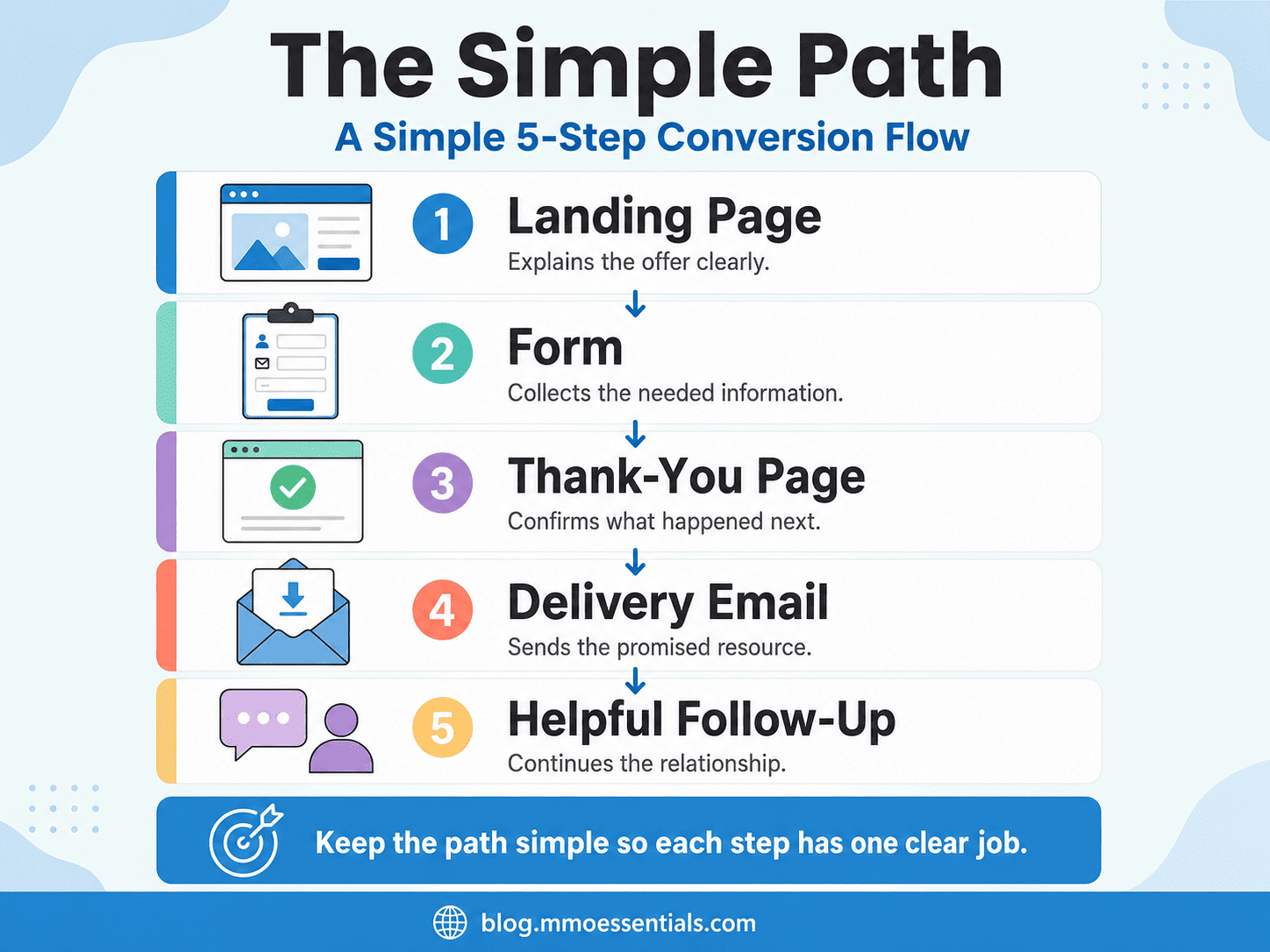
The Simple Path shows how a clear 5-step flow can guide someone from sign-up to follow-up without adding unnecessary confusion.
A Small Place for AI
AI can help with:
Generating headline options
Simplifying a sentence
Turning rough notes into bullet points
Checking whether the message sounds clear
Finding jargon
Drafting a short FAQ
AI should not decide:
Who your page is for
What your offer genuinely does
Which claims are accurate
What evidence you have
What your brand believes
Whether the page is ready to publish
You may already have copy generated by AI, supplied by a vendor, or included inside a template. Treat it as a draft, not as proof that the page is finished.
Keep any useful structure or clear explanations. Remove unsupported claims, vague benefits, generic urgency, and language you would never use when speaking to a real person.
Rewrite the page around what you genuinely know about the audience, offer, limitations, and next step.
AI can help create options. It cannot decide which promise you are prepared to stand behind.
REMEMBER
AI can help with the first version. You remain responsible for the final version.
Common Mistakes
Opening the page builder too early
Decide the purpose, person, offer, and next step before choosing the template.
Trying to speak to everyone
Choose one main person and one immediate problem or goal.
Making the promise bigger than the offer
Promise a useful result that the page can genuinely support.
Adding more when the message is unclear
Rewrite the main message before adding more sections.
Copying language that does not fit
Explain the offer as you would to one real person.
Forgetting what happens after the form
Test the complete path before sharing the page.
Waiting for perfection
Publish the clear, functional first version.
Changing everything at once
Improve one meaningful element at a time.
Trusting generic AI copy
Check accuracy, relevance, tone, and honesty before using it.
Keeping Every Section Because the Template Included It
A template is a starting structure, not a list of compulsory sections. Remove anything that does not help the visitor understand the offer or take the next step.
Blaming the Page Builder for a Message Problem
Changing software will not fix an unclear audience, weak promise, mismatched offer, or confusing action. Check the message before moving the page somewhere else.
Using Vendor Copy Without Checking the Claims
Ready-made copy may include guarantees, urgency, results, or language that does not fit your experience or brand. Keep only what you can explain, verify, and stand behind.
Testing the Design but Not the Journey
A page can look polished and still fail after the form is submitted. Test the confirmation, email delivery, download, redirects, and next step from beginning to end.
Keeping an Old Page Live Because Rebuilding Feels Difficult
Previous effort is not a reason to keep a page that no longer fits. Review it against the CLEAR PAGE Method, improve the useful parts, and archive anything that no longer has a clear job.
Reader Toolkit
This toolkit is designed to be quick to use on a phone or computer.
1. One-Page Landing Page Planner
Who is this page for?
____________________________________________________________
What do they want?
____________________________________________________________
What are you offering?
____________________________________________________________
What should they do next?
____________________________________________________________
What happens after they act?
____________________________________________________________
One-sentence page purpose:
This page helps ______________________________ to ______________________________ without ______________________________.
2. Core Copy Builder
Headline:
____________________________________________________________
Supporting sentence:
____________________________________________________________
Benefit 1:
____________________________________________________________
Benefit 2:
____________________________________________________________
Benefit 3:
____________________________________________________________
Button text:
____________________________________________________________
3. Essential Page Structure
Headline
Supporting sentence
Three clear benefits
Form or button
What happens next
Trust or privacy note where needed
4. Five-Second Clarity Check
What is this?
Who is it for?
What do I get?
Why does it matter?
What should I do next?
5. Mobile Check
The headline is readable.
The button is easy to tap.
The form works.
Nothing is cut off.
Images load properly.
The page does not feel crowded.
The main action is obvious.
6. Full Path Test
TEST THIS
Page → Form or Button → Thank-You Step → Delivery
Every link works.
The form submits.
The correct next page appears.
The promised email or resource arrives.
The visitor knows what to do next.
7. Trust Check
Remove:
Unsupported claims
Fake urgency
Invented proof
Exaggerated values
Pressure-heavy wording
Keep:
Clear expectations
Honest benefits
Genuine proof
Relevant privacy information
A promise the offer can keep
Landing Page FAQ
Do I need a website before building a landing page?
Not always. Some page-building / email platforms can host a standalone landing page. The important thing is that the page has a clear purpose and connects to the correct next step.
Do I need coding skills?
No. Many page builders let you create a useful page without coding.
How long should the page be?
Long enough to answer the visitor's important questions. It shouldn't be any longer.
Do I need testimonials?
No. Use genuine proof when you have it. Do not invent it.
Should I remove the menu?
A focused page often benefits from fewer unrelated links. Keep any privacy, legal, contact, or accessibility links you genuinely need.
Do I need a video?
No. Use video only when it makes the offer easier to understand.
What should I ask for on the form?
Ask only for information you genuinely need. For a basic email sign-up, an email address may be enough.
Can AI write the page?
AI can help with first drafts. You still decide what is accurate, useful, and right for your brand.
What happens after someone submits the form?
They should receive a clear confirmation and the next step you promised.
What should I improve first?
Check the offer, person, headline, call to action, form and next step, in that order.
What if I already have a landing page but do not know whether it is working?
Start with the purpose. Check whether the page is reaching the right people, whether the main action is clear, whether the form or button works, and whether the promised next step happens. Review one part at a time rather than changing the whole page.
What if my page came with a done-for-you funnel?
Map the page in your own words. Identify the audience, offer, promise, button action, next page, delivery, and follow-up. Keep the parts you understand and can support. Pause or remove anything that relies on claims, urgency, or logic you cannot explain.
What if the page looks professional but gets few sign-ups?
Check the traffic, audience fit, offer, headline, promise, form, trust, and delivery path before redesigning it. A design problem is only one possibility.
What if I copied the vendor’s page wording?
Treat it as reference material. Rewrite the message in your own words, remove claims you cannot verify, and make sure the page reflects what your version of the offer genuinely provides.
Should I move the page to different software?
Only when the current tool creates a clear practical problem. New software will not automatically fix unclear copy, a weak offer, or a broken next step.
7-Day Build Plan
Before You Begin
If you already have a landing page, template, or done-for-you setup, use this plan as an audit. You do not need to rebuild it automatically. Keep what supports the page’s purpose, rewrite what feels unclear, and remove anything that competes with the main action.
Day 1: Choose or Confirm the Purpose
Decide the one action the page should help the visitor take.Day 2: Choose or Confirm the Person and Offer
Check that the page speaks to the same person the offer is meant to help.Day 3: Review the Promise and Message
Make sure the headline, supporting copy, and benefits describe what the offer genuinely does.Day 4: Review the Page Structure
Keep the sections that answer the visitor’s questions. Remove repeated claims, competing links, and template filler.Day 5: Prepare the Next Step
Connect the button or form to the correct confirmation, delivery, download, or follow-up.Day 6: Test the Full Journey
Check the page on desktop and mobile. Submit the form, follow every link, and confirm that the promised next step happens.Day 7: Publish or Update and Document
Record what you changed, why you changed it, what you will watch, and the next improvement you may test.
Continue Your Journey
You do not need a collection of landing-page tricks.
You need one clear page built for a real person.
Start with one purpose.
Build one page.
Connect one next step.
Check that it works.
Then learn from what happens.
This Foundation works alongside other MMO Essentials guides:
Email Foundations
Lead Magnet Foundations
AI Tools Foundations
Funnel Foundations
Traffic Foundations
Automation Foundations
Each Foundation helps you understand and build one useful part of your online business.
YOU HAVE BUILT THIS FOUNDATION
Use what you have planned.
Publish the first useful version.
Document what you learn.
Then improve the next version.
Clarity Before Complexity.
Build the Foundation. The Rest Will Follow.
🌱 MMO Essentials Build Log
Today I learned:
__________________________________________________________________________________
Today I built, reviewed, or simplified:__________________________________________________________________________________
One part of the page I understand more clearly now:
__________________________________________________________________________________
One section, claim, link, or action I decided to keep, change, remove, or test:
__________________________________________________________________________________
What surprised me:__________________________________________________________________________________
My next step:_________________________________________________________________________________________________________________________
Next recommended Foundation:
📘Foundation 06 - Funnel Foundations
Build a system that becomes a long-term business asset.
About MMO Essentials

My name is Cherry, and I’m the creator of MMO Essentials.
I created the site to document my journey of building an online marketing brand in real time — taking action, testing tools, creating content, building simple systems, and sharing what I learn along the way.
My goal is to help people build online marketing foundations without overwhelm, confusion, shiny-object distractions, or unrealistic “get rich quick” promises.
I’m not here to pretend that online marketing is instant or effortless.
I’m here to show the real process of starting, improving, and building one step at a time.
My personal ethos is simple:
Start It → Master It → Scale It
Start with the next clear step.
Master the basics through action and practice.
Scale only when the foundation is working.
As MMO Essentials develops, the goal is to keep turning essential online business steps into practical guides, checklists, tutorials, and simple systems.
MMO Essentials Foundations Library
Foundation 05 – Landing Page Foundations
Version 1.2
Published: July 2026
 Powered By LeadCreator