FUNNEL
FOUNDATIONS
Understand How Content, Pages, Email, and Offers Work Together
A practical guide for building a simple customer journey without tech overwhelm, pressure tactics, or unrealistic income promises.
Welcome to the MMO Essentials Foundations Library
Every online business is built on foundations.
Unfortunately, many people are encouraged to chase shortcuts before they understand the basics.
At MMO Essentials, we believe in Clarity Before Complexity.
Each Foundation Workbook focuses on one practical skill you can understand, apply, and build upon.
"Build the Foundation. The Rest Will Follow".
Inside This Workbook
Opening Note
Who This Workbook Is For
What This Workbook Is Not
What Is a Funnel?
Why Funnels Matter
Understanding TOFU, MOFU and BOFU
The CLEAR Funnel Journey
The Essential Funnel Pieces
Building Your First Simple Funnel
Where AI Fits
Common Funnel Mistakes
Reader Toolkit
Common Questions
7-Day Build Plan
MMO Essentials Build Log
How This Connects
Continue Your Journey
About MMO Essentials
Opening Note
If you have spent any time learning about online marketing, you have probably heard that you need a funnel.
Then the explanations begin.
One person says you need several landing pages. Another says you need advanced automation. Someone else has added upsells, downsells, tracking pixels, behavioural tags, SMS reminders, and a diagram that looks like it requires air traffic control.
You may also have followed some of that advice already. Perhaps you imported a complete funnel, connected several tools, loaded a ready-made email campaign, or bought a system where every page and automation appeared to be finished.
The problem was that nobody helped you understand why each piece existed, what order the journey should follow, or what the person moving through it was meant to experience.
That effort is not wasted. It may already contain useful pages, emails, resources, and ideas. The next step is to identify what supports a clear journey and what is simply adding another obstacle.
Before long, a simple customer journey has turned into an online marketing obstacle course.
That is not what we are doing here.
This workbook is about understanding the journey someone takes from discovering your content to taking a meaningful next step.
You will learn how content, pages, email, and offers connect, what TOFU, MOFU, and BOFU mean, and how to map a simple first funnel without getting buried in technology or hype.
The goal is not to build the most complicated system.
The goal is to build one you can understand, document, and improve.
CORE PURPOSE
A funnel should help the right person move from first discovery to a useful next step through a clear, connected journey.
MMO ESSENTIALS INSIGHT
Do not automate confusion. Simplify it first.
Who This Workbook Is For
This workbook may help you if:
You are trying to understand how content, pages, email, offers, and automation fit together without getting buried in technical explanations.
You have heard words such as funnel, opt-in page, lead magnet, automation, TOFU, MOFU, and BOFU but still feel unclear about the full journey.
You want to grow an email list and understand what should happen before and after someone joins.
You have created content, pages, emails, or digital products but have not yet connected them into one simple system.
You have imported templates, pages, campaigns, or automations but still cannot explain why each part exists.
You have bought courses or done-for-you systems that showed you what to install without helping you understand the journey.
You have several tools connected but are unsure what would break if you changed one step.
You have added upsells, tags, branches, or extra emails before the basic path was clear.
You want to simplify what you already have rather than automatically replacing everything.
You are tired of aggressive sales tactics, fake urgency, and unrealistic income promises.
You want AI to assist with planning and first drafts without replacing your judgment.
You have limited time and want to build one useful version before adding more tools or automation.
You may be mapping this journey for the first time. You may also be untangling one that became more complicated than useful.
FOUNDATION REALITY CHECK
You are not starting from zero. You are starting from experience.
What This Workbook Is Not
This is not a promise of instant sales.
This is not a million-pound funnel blueprint, advanced automation course, paid-traffic strategy, high-pressure sales manual, technical coding guide, or complete copywriting programme.
This is not a reason to buy several tools before understanding the process.
This is not a push-button AI funnel builder.
This is not a guarantee that every visitor will become a subscriber or customer.
This is not a collection of secret conversion tricks.
You may already have pages, email campaigns, automations, tags, forms, products, or parts of a ready-made funnel. You do not need to delete everything or begin again automatically. The goal is to map what each piece does, keep what supports the journey, and remove or pause what creates confusion.
This workbook focuses on building—or rebuilding—one clear customer journey you can understand, document, test, and improve.
What Is a Funnel?
A funnel is a connected journey that helps someone move from first discovery to a useful next step.
A funnel is not one page. It is not one email. It is not one tool. It is the way those pieces work together.
SIMPLE SHIFT
Do not think of a funnel as a machine that turns every visitor into money. Think of it as a planned journey that helps the right person understand where to go next.
A useful funnel does not need dozens of steps or complicated software. It needs a clear path that helps the right person move from useful content to a relevant next action.
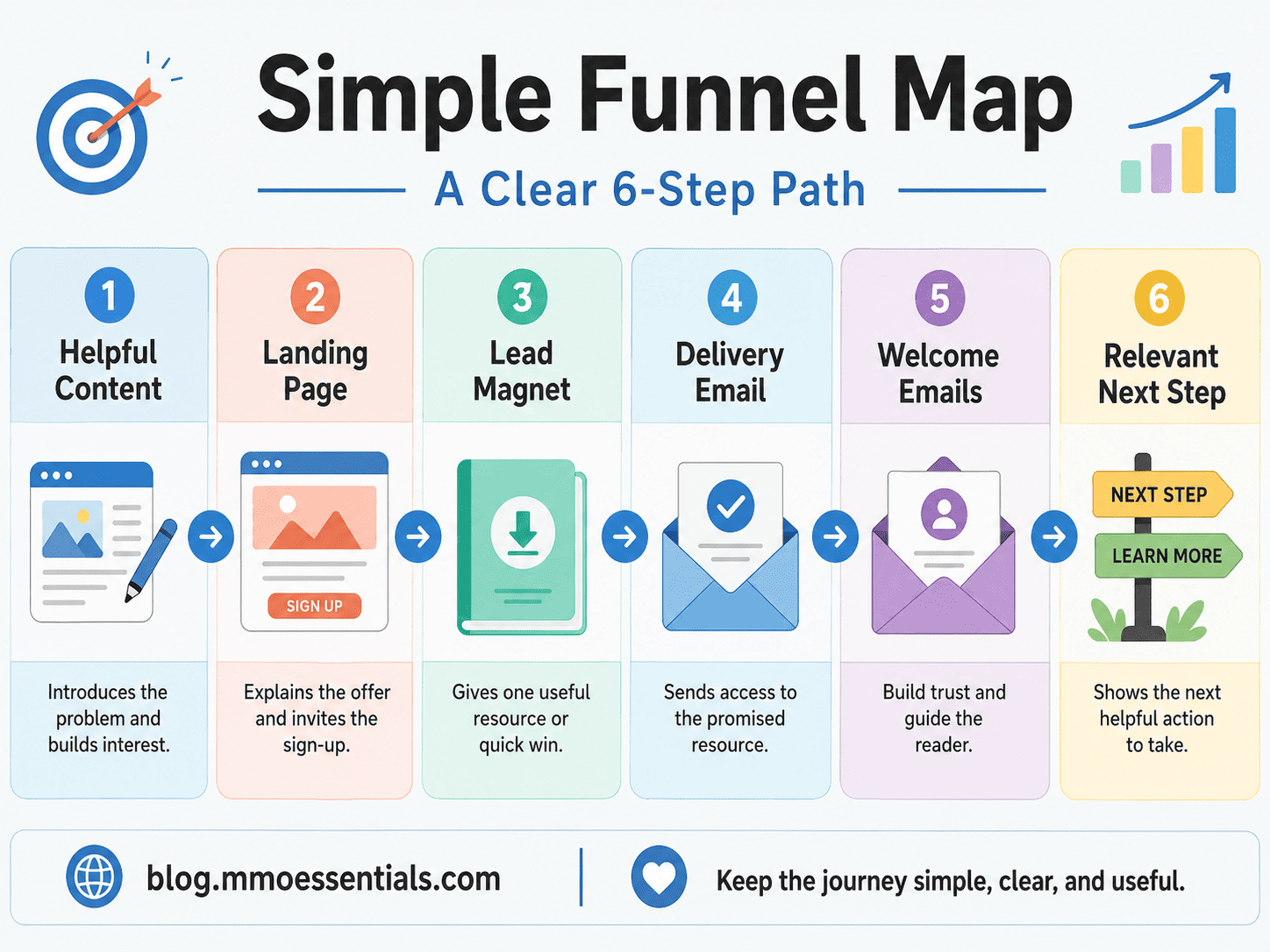
The Simple Funnel Map: six connected stages that turn helpful content into a clear and practical customer journey.
The software may connect the pieces, but the journey begins with people: what they need, what they discover, what they receive, and what makes sense next.
Why Funnels Matter
People may discover your work through a blog post, YouTube video, search result, social post, recommendation, review, or free resource.
Without a clear next step, they may read, watch, click, and then disappear.
A funnel gives that first contact somewhere useful to continue.
It connects temporary attention to an ongoing relationship.
It helps you grow an email list with people interested in a relevant problem.
It gives your content a practical next step.
It helps you deliver what you promised.
It gives you a simple way to follow up.
It creates a path toward a useful offer or recommendation.
It gives you a system you can test, document, and improve.
MMO ESSENTIALS INSIGHT
Once someone discovers your content, a funnel gives them somewhere useful to go next.
Understanding TOFU, MOFU, and BOFU
These terms are common in online marketing. They are simply labels for three stages of the journey.
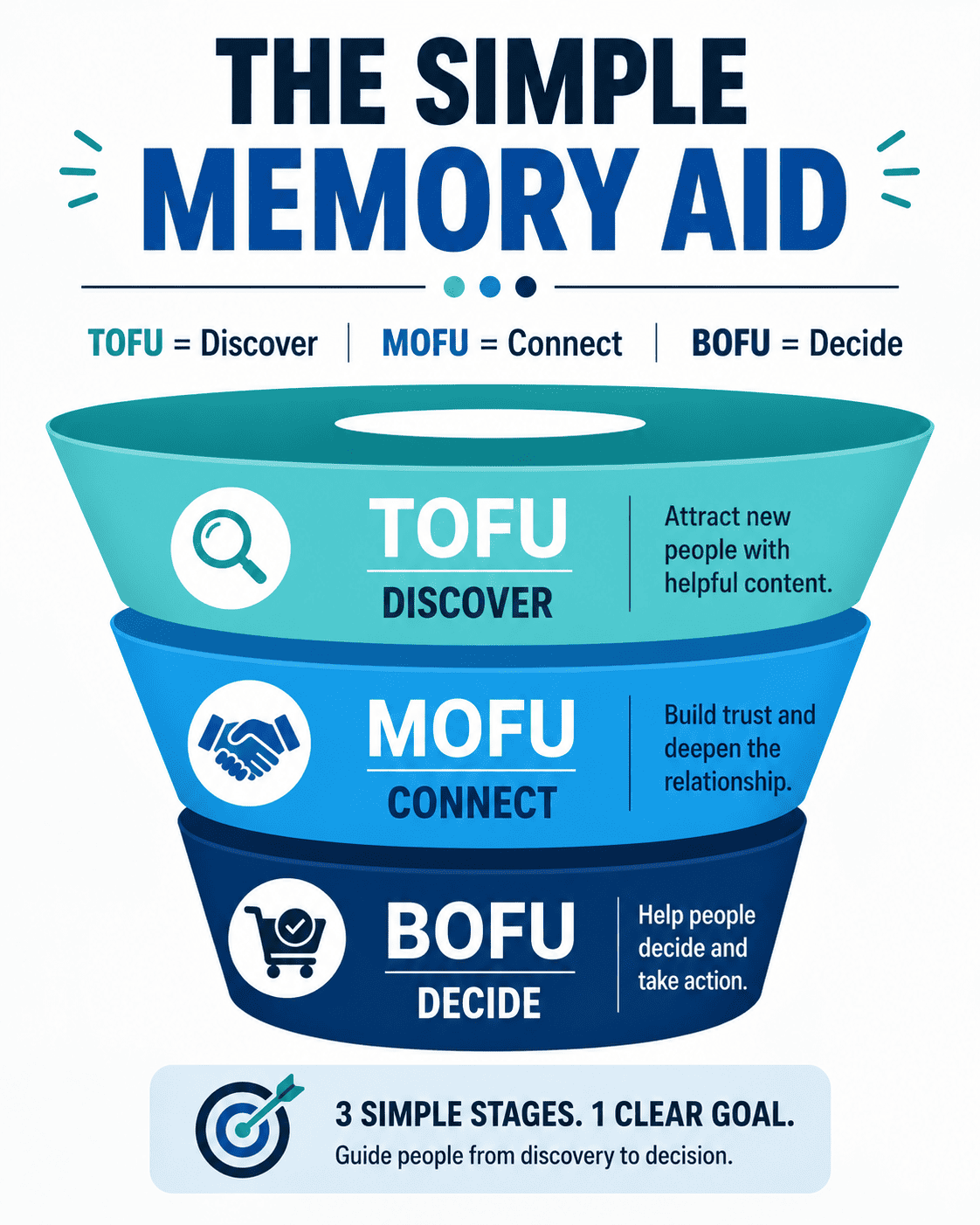
TOFU — Top of Funnel: Discover
This is where someone first becomes aware of your content, message, or business.
A blog post
A YouTube video
A search result
A social post
A recommendation
A free checklist or guide
The reader is asking: “Is this relevant to me?”
Your job is to help the right person find something useful and offer one clear place to continue.
COMMON MISTAKE
Trying to attract everyone. Broad attention may look impressive, but useful attention from the right person is more valuable.
MOFU — Middle of Funnel: Connect
This is where someone begins learning from you and deciding whether your guidance is useful, relevant, and trustworthy.
A lead magnet
An email list
A delivery email
A welcome sequence
Related content
A practical tutorial
The reader is asking: “Can this help me take the next step?”
Your job is to continue being useful, deliver what was promised, and help the person understand the problem more clearly.
MMO ESSENTIALS INSIGHT
The purpose of follow-up is not to remind people that you exist every twelve hours. It is to continue being useful.
BOFU — Bottom of Funnel: Decide
This is where someone considers a more committed next step.
Buying a product
Choosing a recommended tool
Registering for a workshop
Requesting more information
Joining a programme
Continuing with a deeper resource
The reader is asking: “Is this the right next step for me?”
Your job is to present the offer clearly, answer sensible questions, and allow the reader to decide whether it fits.
SIMPLE SHIFT
BOFU is a decision stage, not a pressure stage. A good offer should feel like a logical next step, not a trapdoor.
The CLEAR Funnel Journey
Before choosing funnel software or building pages, it helps to understand the journey you want someone to take.
The CLEAR Funnel Journey breaks that process into five connected stages, helping you plan how a reader moves from discovering your content to receiving support and considering a relevant next step.
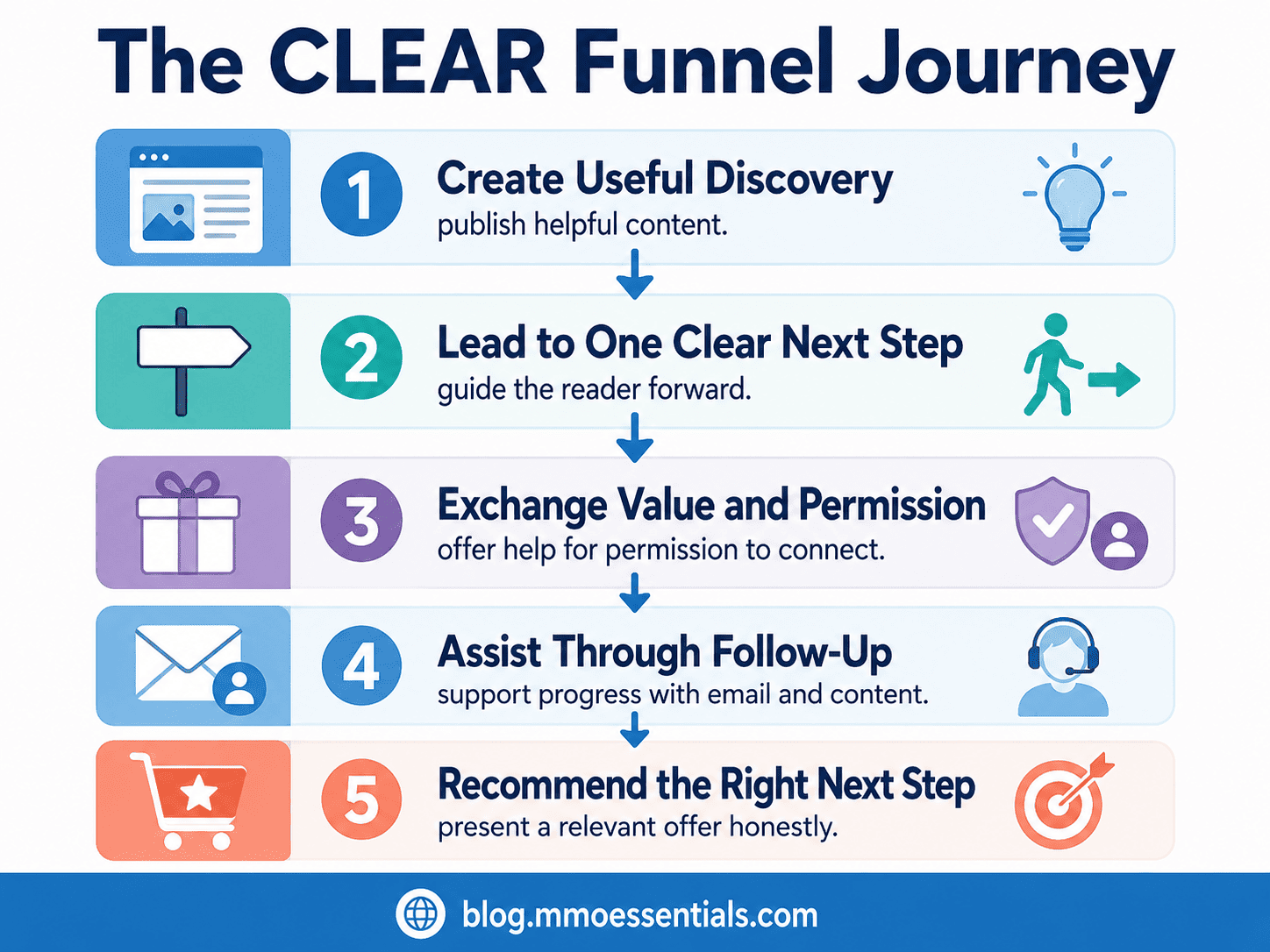
The CLEAR Funnel Journey can help you plan a new funnel or audit one you already have.
If your funnel is already built, do not begin by replacing the software or rewriting every page. Map the current journey exactly as it works today.
Show where the person enters, what they are asked to do, what they receive, what follow-up happens, and what decision appears next.
Then compare that real journey with the CLEAR stages.
A funnel can look sophisticated inside the dashboard and still feel like a corridor full of unmarked doors to the person using it.
CLEAR And The Funnel Stages
TOFU: Create + Lead
MOFU: Exchange + Assist
BOFU: Recommend
The order matters. If the discovery is unclear, the wrong people enter. If the exchange is weak, there is little reason to continue. If the follow-up is unhelpful, the offer feels disconnected.
You do not need to make every stage bigger. You need to make each stage clearer.
The Essential Funnel Pieces
Content
Creates discovery by answering a useful question or solving a small problem.
Ask: What job does this piece perform?
Landing Page
Focuses attention on one offer and one clear action.
Ask: What job does this piece perform?
Lead Magnet or Next-Step Resource
Gives the right person a useful reason to continue.
Ask: What job does this piece perform?
Thank-You or Confirmation Page
Confirms what happened and explains what comes next.
Ask: What job does this piece perform?
Delivery Email
Fulfils the promise and gives access to the resource.
Ask: What job does this piece perform?
Welcome Emails
Continue the relationship with useful, relevant follow-up.
Ask: What job does this piece perform?
Offer or Recommendation
Provides a sensible next step for someone who wants further help.
Ask: What job does this piece perform?
Existing Funnel Audit
If you already have a funnel, list every current piece before adding anything new:
traffic source
content
landing page
form
thank-you page
lead magnet
delivery email
welcome emails
tags
automations
offer pages
upsells or downsells
redirects
tracking linksFor each piece, write down:
What job does it perform?
What happens immediately before it?
What happens immediately after it?
Is it still relevant to the current audience and offer?
Can I explain why it is there?
If a piece has no clear job, duplicates another step, or sends people in a different direction, pause before keeping it simply because the original funnel included it.
SIMPLE REALITY CHECK
A beautifully designed page with no clear job is still a confusing page.
Building Your First Simple Funnel
Start with the smallest complete journey you can understand and manage.
Choose one clear audience and one clear problem.
Choose one discovery asset, such as a blog post or short video.
Choose one relevant next step, such as a lead magnet or email sign-up.
Create one focused landing page.
Prepare one delivery or confirmation message.
Write a short welcome sequence.
Choose one useful offer, resource, or recommendation.
Test the full journey from beginning to end.
Publish the first version and document what happens.
FIRST-VERSION FUNNEL
Blog post or video → Landing page → Lead magnet → Delivery email → Two helpful welcome emails → Relevant next step
You can add tags, branches, upsells, retargeting, and advanced tracking later if the simple journey proves that it needs them.
MMO ESSENTIALS RULE
Do not automate confusion. Simplify it first.
Where AI Fits
AI can reduce the friction around planning and first drafts. It should support your thinking, not replace it.
AI Can Help You
Map a first-version funnel
Draft page headlines and short explanations
Outline delivery and welcome emails
Simplify technical wording
Suggest clear audience questions
Review the journey for missing steps
Turn one piece of content into several formats
AI Cannot Reliably
Know your audience without context
Guarantee every fact is correct
Replace your judgment
Create real experience
Build trust on your behalf
Guarantee leads, sales, or conversion rates
Decide whether an offer is genuinely suitable
You may already have a funnel map, email sequence, or page copy created by AI or supplied inside a ready-made system. Treat it as a draft, not as evidence that the journey makes sense.
Review whether the audience, problem, promise, next step, and follow-up are genuinely connected. Remove claims you cannot support, examples that are not real, and branches created only because the tool suggested them.
AI can produce ten extra funnel steps before breakfast. That does not mean any of them have earned a place.
Keep the simplest path that delivers what was promised and helps the person move forward clearly.
AI REALITY CHECK
AI can help create the first version. You remain responsible for the final experience.
Common Funnel Mistakes
Starting With Software
The tool begins deciding the journey. Map the person, problem, and next step before choosing features.
Adding Too Many Actions
The visitor does not know what to do. Give each stage one main job and one obvious next step.
Automating Too Early
A confusing system becomes faster and harder to fix. Run a simple version first.
Treating Every Visitor Like a Buyer
The journey becomes pushy. Match the message to the person’s stage.
Collecting Leads Without Follow-Up
The subscriber receives the free resource and then hears nothing useful. Prepare a short welcome sequence before promoting the funnel.
Copying Someone Else’s Funnel
The pages may look complete, but you do not understand why they are there. Borrow ideas, not unexplained complexity.
Measuring Only Sales
Early versions also teach you whether people reach the page, take the next step, receive the resource, and engage with the follow-up.
Keeping Every Step Because the Funnel Came That Way
A ready-made funnel is a starting structure, not a compulsory journey. Remove any page, email, branch, or offer that does not support the person’s next useful step.
Connecting Tools Before Mapping the Experience
A technically connected system can still feel confusing. Map what the person sees and receives before celebrating that the apps are speaking to each other.
Using Tags and Automations Nobody Can Explain
If you do not know what triggers a tag, email, branch, or workflow, document it before changing or adding anything.
Letting an Old Offer Control the Current Journey
A funnel may have been built around an offer you no longer use or an audience you no longer serve. Review the destination before improving the route.
Testing Individual Pieces but Not the Full Path
A page, form, and email may each work separately while the full journey still breaks. Test the experience from first discovery to final next step.
Adding More Automation to Fix Weak Follow-Up
More emails do not repair irrelevant or unhelpful communication. Improve the message before increasing the volume.
Reader Toolkit
1. Map Your First Funnel
Someone finds me through: ____________________________
They take the next step by: __________________________
They receive: _______________________________________
I follow up with: ___________________________________
The next relevant offer or action is: _______________
YOUR FINISHED PATH
Discover → Continue → Receive → Follow Up → Decide
2. TOFU, MOFU, BOFU Quick Guide
TOFU — Discover: What useful first contact brings the right person into the journey?
MOFU — Connect: What helps this person understand, trust, and continue?
BOFU — Decide: What relevant next step makes sense after trust has been built?
3. Minimum Viable Funnel Checklist
☐ One useful piece of content
☐ One clear landing page
☐ One relevant lead magnet or next step
☐ One delivery or confirmation email
☐ A short welcome sequence
☐ One clear offer, resource, or recommendation
☐ One simple way to check what happened
4. Funnel Clarity Check
☐ Is this journey for one clear type of person?
☐ Does each step have one main job?
☐ Is the next action obvious?
☐ Does the visitor receive what was promised?
☐ Does the follow-up continue being useful?
☐ Is the offer relevant to the journey?
☐ Can I explain the full funnel in one minute?
☐ Can I manage this system consistently?
If the answer to the last two is no, simplify it.
5. AI Funnel Builder Prompt
COPY AND ADAPT
Help me map a simple funnel for [audience].
They are trying to [goal].
They may first find me through [content or traffic source].
I want the next step to be [lead magnet, email sign-up, product, or other action].
Keep the funnel clear, practical, and limited to the essential steps.
Show me:
1. The TOFU stage
2. The MOFU stage
3. The BOFU stage
4. The purpose of each step
5. What can wait until later
Avoid aggressive sales tactics, complicated automation, fake scarcity, and unrealistic promises.
6. What Can Wait Until Later?
Advanced tagging
Complex email branching
Paid retargeting
SMS reminders
Browser notifications
Multiple upsells
Downsells
Webinars
Advanced split testing
Detailed customer scoring
Multi-platform tracking
Add these only when the simple journey is already clear and there is a practical reason to add them.
Common Questions
Do I need paid funnel software?
No. You need a clear journey first. Software only helps you build and connect the steps.
How many pages does a first funnel need?
Possibly only one landing page and one thank-you or confirmation page. The right number depends on the job the funnel needs to do.
Do I need an upsell?
No. An upsell is optional. Add one only when it genuinely helps the buyer continue.
Is a lead magnet always required?
No. Some funnels lead directly to content, a trial, a registration page, or an offer. A lead magnet is useful when email follow-up supports the journey.
How many emails should I write?
Start with a delivery email and a short welcome sequence. Three helpful emails are more useful than twelve rushed ones.
Can AI create my funnel?
AI can help map the journey, draft pages, suggest emails, and spot gaps. You still need to check the logic, relevance, facts, tone, and final experience.
What should I track first?
Check whether people reach the page, take the next step, receive what was promised, open the follow-up, and click toward the next relevant action.
What if I already have a funnel but cannot explain how it works?
Map the current journey on paper. Start with where someone enters and follow every page, form, email, redirect, offer, and branch. Write down the purpose of each step. Do not add anything until you can explain the existing path clearly.
What if my funnel came with a done-for-you system?
Treat the supplied funnel as a draft. Check whether the audience, promise, emails, offers, urgency, and follow-up fit your business. Keep what you understand and can support. Pause anything that depends on claims or logic you cannot explain.
What if I have too many automations and tags?
Document what triggers each one and what happens next. Remove duplicates, outdated rules, and branches that no longer serve a useful purpose.
What if the funnel works technically but people still seem confused?
Review the message and journey from their point of view. Check whether each page explains what is happening, whether the next action is obvious, and whether the follow-up matches what they expected.
Should I rebuild the funnel in different software?
Only when the current tool creates a clear practical limitation. New software will not automatically fix a weak offer, unclear journey, mismatched follow-up, or unnecessary steps.
SIMPLE REALITY CHECK
You do not need a dashboard that looks like mission control.
7-Day Build Plan
Before You Begin
If you already have pages, forms, emails, automations, offers, or a done-for-you funnel, use this plan as an audit. Do not rebuild everything automatically. First map what exists, keep what supports the journey, and pause anything you cannot explain.
Day 1 — Choose or Confirm the Journey
Decide who the funnel is for, what they need, and the useful next step it should support.
Day 2 — Map TOFU, MOFU, and BOFU
Show where the person discovers you, how they continue, and what decision appears later.
Day 3 — Audit the Essential Pieces
List the current pages, emails, forms, assets, automations, and offers. Keep only the pieces with a clear job.
Day 4 — Review the Landing Page and Entry Point
Check the headline, promise, action, form, and connection to the next step.
Day 5 — Review the Delivery and Follow-Up
Confirm that the person receives what was promised and that the emails continue being useful.
Day 6 — Test the Full Journey
Enter through the real traffic source. Submit the form, follow every link, open every email, and complete the path on desktop and mobile.
Day 7 — Publish or Update and Document
Record what you kept, changed, removed, paused, and still need to investigate.
ONE-MINUTE FUNNEL REVIEW
Can I explain who this funnel is for?
Can I explain what happens at TOFU, MOFU, and BOFU?
Can I explain the purpose of every page and email?
Can I identify one next step at each stage?
Can I manage this system without feeling overwhelmed?
If yes, the funnel is ready for its first real use. If not, remove something before adding anything.
How This Connects
You may have discovered MMO Essentials through this workbook, so you do not need to have read anything else before using it.
Funnel Foundations gives you the wider picture of how content, pages, email, lead magnets, and offers can work together.
When you are ready to explore one part in more detail, other MMO Essentials Foundation workbooks can help you go deeper into topics such as:
Landing pages
Lead magnets
Email marketing
SEO and searchable content
Affiliate marketing
Practical AI use
You do not need to build everything at once.
Choose the Foundation that matches your next step and strengthen the system one piece at a time.
Remember
You do not need a complicated funnel to begin.
You need a clear journey.
Start with one useful piece of content.
Connect it to one sensible next step.
Follow up in a way that continues helping.
Then watch what happens, document what you learn, and improve the next version.
MMO ESSENTIALS REMINDER
Action, not perfection, will always win the race.
🌱 MMO Essentials Build Log
Today I learned:
____________________________________________________________________________________________________________
Today I mapped, built, reviewed, or simplified:__________________________________________________________________________________
One part of the journey I understand more clearly now:
__________________________________________________________________________________
One page, email, automation, offer, or connection I decided to keep, change, remove, or test:
__________________________________________________________________________________
One place where the journey may still feel unclear:
____________________________________________________________________________________________________________
What surprised me:____________________________________________________________________________________________________________
My next step:____________________________________________________________________________________________________________
Continue Your Journey
Next recommended Foundation:
📘Foundation 07 - Bonuses Foundations
Create useful bonuses that complement and enhance the user's experience.
About MMO Essentials

My name is Cherry, and I’m the creator of MMO Essentials.
I created the site to document my journey of building an online marketing brand in real time — taking action, testing tools, creating content, building simple systems, and sharing what I learn along the way.
My goal is to help people build online marketing foundations without overwhelm, confusion, shiny-object distractions, or unrealistic “get rich quick” promises.
I’m not here to pretend that online marketing is instant or effortless.
I’m here to show the real process of starting, improving, and building one step at a time.
My personal ethos is simple:
Start It → Master It → Scale It
Start with the next clear step.
Master the basics through action and practice.
Scale only when the foundation is working.
As MMO Essentials develops, the goal is to keep turning essential online business steps into practical guides, checklists, tutorials, and simple systems.
MMO Essentials Foundations Library
Foundation 06 – Funnel Foundations
Version 1.1
Published: July 2026
 Powered By LeadCreator