AFFILIATE BONUS
FOUNDATIONS
Build Useful Bonus Assets That Help Buyers Take Action
A practical guide for creating affiliate bonuses that support the main product without oversized bundles, inflated values, artificial scarcity, or complicated delivery systems.
Welcome to the MMO Essentials Foundations Library
Every online business is built on foundations.
Unfortunately, many people are encouraged to chase shortcuts before they understand the basics.
At MMO Essentials, we believe in Clarity Before Complexity.
Each Foundation Workbook focuses on one practical skill you can understand, apply, and build upon.
"Build the Foundation. The Rest Will Follow".
Inside This Workbook
Opening Note
Core Purpose
Who This Workbook Is For
What This Workbook Is Not
By the End of This Foundation
What Is an Affiliate Bonus?
Why Affiliate Bonuses Matter
The BONUS Asset Method
Part 1: Begin With the Main Product
Part 2: Observe the Buyer Gap
Part 3: Name the Simplest Useful Asset
Part 4: Use AI and Simple Tools Carefully
Part 5: Set Up Clear Delivery
Honest Value Without Inflated Claims
Real Scarcity Versus Manufactured Pressure
Vendor Bonuses and Licensing
Common Affiliate Bonus Mistakes
Reader Toolkit
Common Questions
Seven-Day Build Plan
MMO Essentials Build Log
About MMO Essentials
Opening Note
Affiliate bonus pages can make the whole process look far more complicated than it needs to be.
You may have seen promotions with twenty downloads, giant value totals, flashing countdown timers, "exclusive" resources, AI tools, template packs, private groups, and enough urgency to make buying a small digital product feel like a national emergency.
You may also have bought offers because the bonus stack looked more valuable than the main product—or created similar stacks yourself because one focused resource did not seem impressive enough.
Perhaps you gathered old PLR, templates, prompt packs, training videos, or unused downloads into one folder without being able to explain how each item helped the buyer use the main product.
That effort is not automatically wasted. Some of those assets may still contain useful ideas, examples, or tools. The next step is to decide what genuinely supports the buyer and what is simply adding weight.
That is not what we are doing here.
A useful affiliate bonus has a much simpler purpose.
It helps the buyer understand, start, apply, or complete the main product.
You do not need the biggest stack.
You do not need ten unrelated PDFs.
You do not need to attach an imaginary £997 value to a checklist you created over lunch.
You need one useful asset that supports the buyer and makes the main offer easier to use.
If you have delayed creating a bonus because you thought it required several products, an expensive design, advanced automation, or a complicated claims process, this Foundation will help you reduce the idea to one clear, practical asset.
You will learn how to identify a genuine buyer gap, choose the simplest, most useful format, create the first version, describe its value honestly, and deliver it clearly.
The goal is not to impress people with volume.
The goal is to help them make progress.
Core Purpose
CORE PURPOSE: Create one useful affiliate bonus asset that helps the buyer take the next practical step.
MMO ESSENTIALS POINT OF VIEW: A bonus should earn its place. If it does not make the main product clearer, easier, faster, or more practical to use, it is not adding value. It is adding weight.
Who This Workbook Is For
This workbook may help you if:
You want to understand how affiliate bonuses work without turning one useful idea into a digital warehouse.
You are tired of oversized promises, giant bonus stacks, and offers that make quantity look more important than usefulness.
You want your affiliate recommendations to include practical support rather than another pile of unrelated downloads.
You have created or collected bonuses before and now want a calmer, clearer process for deciding what genuinely deserves to stay.
You already understand affiliate promotions but want to simplify a bonus strategy that has become larger or more complicated than useful.
You have used PLR, vendor packs, templates, prompts, or old downloads without changing them enough to fit the product or buyer.
You have offered several bonuses but cannot clearly explain what problem each one solves.
You have built attractive resources that buyers rarely opened, used, or completed.
You want AI to support planning and first drafts without replacing your judgment.
You are building around work, family, and limited available time.
You want to create useful support assets without pressure tactics, fake scarcity, or inflated values.
You may be planning your first affiliate bonus. You may also be reviewing a folder full of assets that once looked generous but never became easy to use. Either way, you are not starting from nothing.
What This Workbook Is Not
This is not a method for forcing people to buy.
This is not a giant bonus-bundle challenge.
This is not a promise of instant commissions.
This is not a lesson in fake scarcity or inflated value.
This is not a folder of random PLR downloads presented as a strategy.
This is not an advanced automation course.
This is not permission to edit, rename, upload, distribute, or resell content you do not have the right to use.
You may already have old bonuses, vendor packs, templates, PLR, AI drafts, checklists, videos, or delivery folders. You do not need to publish all of them or delete all of them automatically. The goal is to review each asset against the main product, buyer gap, licence, usefulness, and delivery experience.
This workbook focuses on creating—or rebuilding—one useful bonus asset with a clear reason to exist.
By the End of This Foundation
You will be able to:
understand what makes an affiliate bonus useful
identify the buyer's most important implementation gap
choose the smallest useful bonus format
create the first version with simple tools
use AI without handing over your judgment
describe the bonus value honestly
check vendor permissions
set up a clear delivery process
improve the asset through real use
You should finish with one planned bonus asset, not a page full of ideas waiting to become another unfinished project.
What Is an Affiliate Bonus?
An affiliate bonus is an additional resource you provide when someone purchases a product through your affiliate link.
The buyer receives the main product from the vendor. They receive your bonus separately.
A useful bonus should connect directly to the product they purchased.
SIMPLE DEFINITION:
An affiliate bonus is a supporting asset designed to make the main product easier to understand, use, or implement.
Examples include:
a checklist
a quick-start guide
a template
a planner
a prompt set
a short tutorial
a glossary
a setup guide
a resource list
a simple workflow
an implementation worksheet
The bonus should not compete with the main product. It should support it.
Important Distinction
A bonus is not automatically useful because it is free.
A resource becomes useful when it solves a relevant problem.
A fifty-page report that the buyer never opens has less practical value than a one-page checklist they use immediately.
Why Affiliate Bonuses Matter
Affiliate bonuses can help a buyer move from information to action.
A course may explain the full strategy but leave the reader unsure where to begin.
Software may offer many features but still leave the buyer staring at a blank dashboard without knowing which action to take first.
A training programme may provide several hours of lessons, but no short implementation plan.
A useful bonus can close that gap.
Illustrative Example: The Course That Teaches Too Much at Once
Imagine a buyer purchases an email marketing course with twelve modules. The course is thorough. It covers platforms, lists, campaigns, automations, and results.
The problem is not missing information. The problem is deciding what to do first.
A useful bonus might be called "Your First 30 Minutes: Email Marketing Quick-Start Guide." It could direct the buyer to choose one platform, create one list, write one welcome email, send a test message, and record the next step.
That bonus does not replace the course. It gives the buyer a starting point.
SIMPLE SHIFT: Do not ask, "How many bonuses can I add?" Ask, "What may stop the buyer from using the main product?"
MMO ESSENTIALS REALITY CHECK: More files do not automatically create more value. Sometimes they create more scrolling. A buyer who already feels overwhelmed does not need fifteen extra resources and a treasure map. They need clarity.
The BONUS Asset Method
Most bonus problems begin when someone starts building before they understand what the buyer actually needs.
The BONUS Asset Method keeps the decisions in the correct order.
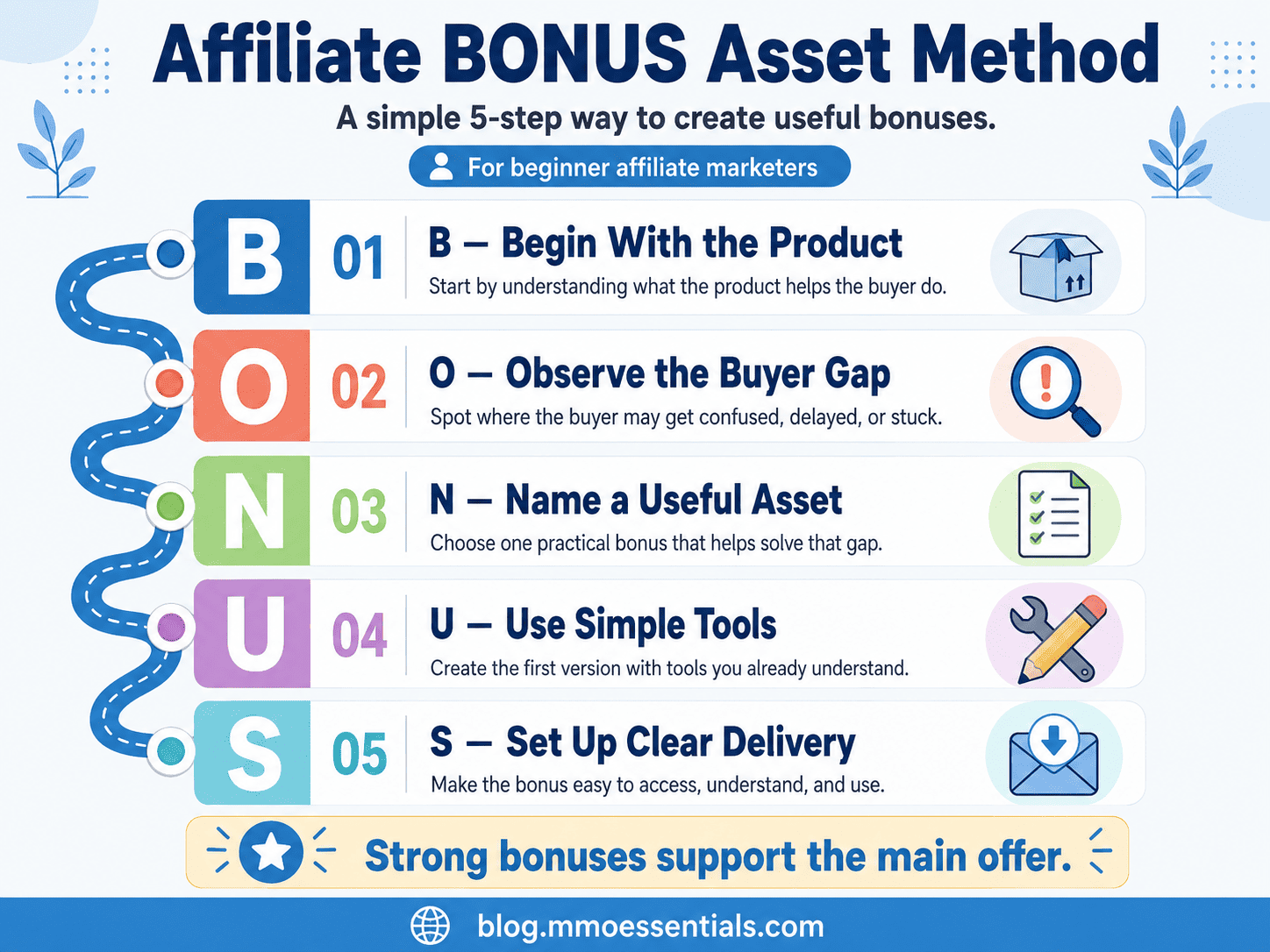
The BONUS Asset Method can help you create a new bonus or audit one you already have.
If you already have a bonus folder, do not begin by redesigning the covers or adding another file. Work through the method in order.
Check the main product first. Then identify the buyer gap. Only after that should you decide whether each existing asset still deserves a place.
A bonus stack can look generous while quietly asking the buyer to organise it themselves.
Product -> Gap -> Asset -> Build -> Deliver
The goal is not to build everything at once. The goal is to create a working bonus you can improve through real use.
Why the Method Uses This Order
If you choose the asset before understanding the product, you may end up creating something irrelevant.
If you build before identifying the buyer gap, you may solve a problem the buyer does not have.
If you create the resource but ignore delivery, the buyer may never use it.
Each stage prevents a different kind of wasted effort.
Part 1: Begin With the Main Product
A useful bonus begins before you open an image creation tool (like Canva), write a prompt, or create a folder.
It begins with understanding the main product.
Do not begin with a folder of old downloads and try to force them into the offer. That is how bonus bundles develop strong miscellaneous-drawer energy.
Start with the product.
What result does it promise?
Who is it for?
What does it help the buyer do?
What knowledge does it assume?
What step may feel difficult?
What happens immediately after purchase?
What could help the buyer get started faster?
Product Review Questions
A useful review looks beyond the sales page. Where possible, examine:
the product outline
the lesson titles
the included templates
the expected skill level
the software required
the first action the buyer must take
the questions buyers are likely to ask
You are not looking for reasons to criticise the product. You are looking for places where practical support may help.
Example: Software With a Blank Dashboard
Main Product: A landing page builder.
Likely Gap: The buyer can use the software but does not know what to place on the page.
Useful Bonus: A one-page landing page planner covering the visitor, problem, offer, main benefit, button text, and next page.
Why It Fits: The software solves the building problem. The bonus solves the planning problem.
FOUNDATION BUILDER: Complete the three statements below.
The main product helps the buyer:
____________________________________________
The buyer may struggle with:
____________________________________________
A useful bonus could help by:
____________________________________________
Part 2: Observe the Buyer Gap
Once you understand the product, the next task is not choosing a file format.
It is identifying where the buyer may need extra support.
A buyer gap is the point where the product may leave someone unsure, delayed, or overwhelmed.
This does not mean the main product is poor. No product can cover every situation in every format.
The bonus fills the implementation gap.
The Four Buyer Gaps:
1. The Clarity Gap
The buyer does not fully understand what something means.
Helpful bonuses include:
glossary
simplified summary
visual map
plain-english explanation
frequently asked questions
2. The Starting Gap
The buyer understands the idea but does not know what to do first.
Helpful bonuses include:
quick-start guide
first-step checklist
setup planner
seven-day plan
decision worksheet
3. The Action Gap
The buyer knows what to do but needs something practical to help complete it.
Helpful bonuses include:
template
swipe file
prompt set
planner
worksheet
example structure
4. The Consistency Gap
The buyer starts but may struggle to continue.
Helpful bonuses include:
progress tracker
repeatable workflow
weekly checklist
documentation sheet
review process
Existing Bonus Audit
If you already have bonuses, list every asset before adding anything new:
✅ PDFs
✅ templates
✅ prompt packs
✅ checklists
✅ tutorials
✅ videos
✅ spreadsheets
✅ PLR
✅ vendor bonuses
✅ resource lists
✅ private groups
✅ AI tools
✅ delivery pagesFor each asset, ask:
Which product does this support?
Which buyer gap does it solve?
Does it duplicate the main product?
Can the buyer use it immediately?
Does the licence allow this use?
Can I explain its value without inventing a price?
Does it make delivery clearer or more confusing?
If you cannot connect an asset to the product and one clear buyer gap, pause before keeping it simply because it took time to create.
Illustrative Gap Examples
Online Course
Likely Gap: The buyer watches lessons but does not implement them.
Useful Bonus: An implementation tracker with one action beside each module.
AI Tool
Likely Gap: The buyer receives generic results because their instructions are unclear.
Useful Bonus: A prompt-planning sheet covering task, audience, context, tone, format, and limits.
Affiliate Marketing Training
Likely Gap: The buyer understands affiliate links but does not know what content to create.
Useful Bonus: A content planner built around questions, comparisons, tutorials, and honest reviews.
Canva Template Pack
Likely Gap: The buyer has templates but does not know which one to use first.
Useful Bonus: A Choose Your Template guide organised by purpose.
MMO ESSENTIALS NOTE: The best bonus idea is rarely the most impressive one. It is usually the one that solves the clearest obstacle.
QUICK WIN: Choose one gap only: clarity, starting, action, or consistency. One useful gap is enough for the first version.
Part 3: Name the Simplest Useful Asset
The buyer gap tells you what needs solving.
Now choose the smallest asset that can solve it.
Do not create a mini course when a one-page checklist will do.
Do not build a portal when a clear document is enough.
Do not build a Custom GPT because it sounds impressive if the buyer only needs three examples and a template.
Useful before impressive.
The Smallest Useful Version Test
What must this asset help the buyer do?
What information is essential?
What can be removed?
Can it be used on a phone?
Will the buyer know what to do first?
Could a smaller version solve the same problem?
Example: Three Possible Bonus Sizes
Main Product: A short-form video course.
Oversized Version:
thirty video templates
fifty hooks
one hundred content ideas
editing tutorials
Canva graphics
a private group
an AI assistant
Medium Version:
ten video structures
ten hooks
a weekly planner
a recording checklist
Smallest Useful Version: "The First Five Videos Planner" with one problem, one tip, one example, and one next step for each video.
The smallest version may be the strongest starting point because the buyer can use it immediately.
MMO ESSENTIALS OPINION: Affiliate promotions often place heavy emphasis on perceived value. That advice is incomplete. First increase practical usefulness. Perceived value may help someone choose. Practical value is what helps them feel glad they chose.
Part 4: Use AI and Simple Tools Carefully
Once the format is clear, the tools become easier to choose.
Start with what helps you finish the first useful version.
AI can help with:
organising rough notes
listing buyer questions
simplifying explanations
drafting a checklist
comparing bonus ideas
creating a worksheet structure
spotting missing instructions
turning one idea into several formats
AI should not decide everything. It does not know the product, audience, licence, or your judgment unless you provide that context.
Better AI Context
A weak request might be: "Create an affiliate bonus."
A stronger request might be: "I am creating a practical affiliate bonus for a course about email marketing. The buyer understands the basic idea but may not know what to send first. Suggest five small bonus assets that help them plan and write their first three emails. Keep the ideas mobile-friendly and possible to create in Google Docs or Canva."
The stronger request gives AI the product, audience, buyer gap, desired outcome, size, format, and tool limits.
AI Review Questions
Is this accurate?
Does it fit the product?
Is it suitable for the intended reader?
Is any step missing?
Does it promise too much?
Does it sound like the brand?
Does it contain invented facts or claims?
Is the final asset easier to use than the raw response?
You may already have an AI-generated checklist, workbook, prompt pack, or guide that looks complete but could belong to almost any offer.
Do not assume the whole asset needs deleting. Review it for useful ideas, remove unsupported claims, replace generic examples, and rebuild the structure around the actual product and buyer gap.
Check whether the resource helps the buyer do something specific. If it mainly repeats information from the sales page or main product, it is not yet earning its place.
AI can make a bonus look finished very quickly. That is not the same as making it useful.
STRONG BOUNDARY: AI can speed up drafting. It cannot provide real experience you do not have. Do not allow it to invent case studies, results, testimonials, expert quotes, product features, conversion statistics, or licensing permissions.
A polished invention is still an invention.
For a fuller practical process for using AI without handing over your judgment, see the AI Tools Foundations.
Simple Tools You May Already Have
Google Docs
Microsoft Word
Canva
ChatGPT
Google Drive
a screen recorder
a spreadsheet
a basic page builder
Use the tool that helps you finish. The best tool is not always the newest one. It is usually the one you understand well enough to use today.
Part 5: Set Up Clear Delivery
Creating the asset is not the end of the process.
The buyer still needs to receive it, understand it, and know what to do first.
If you already have a delivery page or folder, test it as though you have never seen it before.
Check:
Is the first instruction obvious?
Are the files named clearly?
Is the most useful asset easy to find?
Do the links work when you are logged out?
Are editable and read-only versions labelled?
Can the buyer use the files on a phone?
Is any access limit or expiry explained honestly?
Does the buyer know which asset to use first?
A delivery folder can contain valuable material and still feel like a cupboard opened during an earthquake. Organisation is part of the bonus.
what they are receiving
how to access it
what to open first
what each file does
where to ask for help
whether access expires
what happens after they submit proof of purchase
The Start Here Rule
Every bonus package should include a clear first instruction.
Start with the Quick-Start Guide. It explains how to use the planner and checklist in the correct order.
This may seem obvious. It is also one of the easiest things to forget.
Simple Delivery Options
a cloud folder
a download page
an email
a private document link
a course area
an affiliate platform's bonus delivery field
a simple confirmation form
Start with the easiest option you can manage reliably. Automation can come later.
Manual Delivery Is Still Delivery
If you are starting with a small audience, manual delivery may be perfectly manageable:
The buyer sends proof of purchase.
You confirm the purchase.
You send the bonus access link.
You record the delivery.
You improve the process if volume increases.
MMO ESSENTIALS NOTE: Delivery is not an admin task added after the bonus. Delivery is part of the bonus. A useful asset hidden behind confusing instructions is not fully useful.
Honest Value Without Inflated Claims
A bonus can be valuable without pretending a short checklist is worth £997.
Value can come from:
saved time
reduced confusion
a clearer starting point
fewer avoidable mistakes
a reusable process
faster implementation
better organisation
easier decision-making
Weak Value Statement
This incredible resource has a real-world value of £497.
The reader still does not know what it does.
Stronger Value Statement
This checklist gives you the essential steps in one place, so you can set up your first campaign without repeatedly searching through the course.
The second statement explains the practical benefit.
Honest Pricing Context
There is nothing wrong with assigning a price to a genuine standalone product.
The problem begins when the number is invented only to make the stack look larger.
Would I genuinely sell this asset by itself for that price?
If the answer is no, the claim probably needs another look.
Real Scarcity Versus Manufactured Pressure
Scarcity should describe a real limit.
Real examples include:
a live session with a fixed date
a review service with limited capacity
a bonus tied to an actual launch period
access connected to a scheduled event
a resource that will genuinely be removed
Manufactured pressure includes:
countdown timers that reset
fake quantity limits
false closing dates
repeated final chances
claims that spaces are nearly gone when no limit exists
MMO ESSENTIALS POSITION: Urgency can be honest. Pressure can be manufactured. The difference is whether the reason is real.
Practical Example
Honest: "I can review the first ten completed landing pages because each review requires individual time."
Manufactured: "Only ten copies of this downloadable PDF exist."
A digital file does not become scarce because the sales page says so.
If the limit is real, explain it clearly. If the limit is not real, do not invent one.
Trust is harder to rebuild than a countdown timer is to install.
Vendor Bonuses and Licensing
Some vendors provide official affiliate bonuses. These may include reports, templates, graphics, training, checklists, or promotional packs.
Before changing anything, check the licence.
Licensing Is Not a Technicality
Receiving a file does not automatically mean you can edit it, rename it, remove the author, add your branding, resell it, upload it into an AI tool, combine it with another product, or distribute it outside the promotion.
Permission depends on the licence.
Licensing Questions
Can I rename it?
Can I edit the text?
Can I change the graphics?
Can I add my branding?
Can I combine it with another asset?
Must I preserve the author's name?
Can I distribute it only to verified buyers?
Does the licence permit commercial use?
Does it include PLR, resell rights, or personal-use rights?
Can I upload it into an AI tool?
Do not assume. If the vendor has not provided editing rights, distribute the resource as supplied.
Curation Is Still Valuable
You do not need to use every vendor bonus.
Choose the most relevant ones, then provide a short guide explaining what each resource is, who should use it, what to open first, and how it connects to the main product.
Curation can be more useful than quantity.
MMO ESSENTIALS NOTE: Respecting the licence is not only about avoiding problems. It is part of building a trustworthy business.
Common Affiliate Bonus Mistakes
Mistake 1: Starting With Random Files
Why It Backfires: The bonus feels disconnected from the main product.
Better Approach: Begin with the product and identify the buyer gap.
Mistake 2: Creating Too Much
Why It Backfires: The project becomes difficult to finish and harder for the buyer to use.
Better Approach: Create the smallest useful version first.
Mistake 3: Confusing Quantity With Value
Why It Backfires: The buyer receives more material but less clarity.
Better Approach: Explain why each asset exists.
Mistake 4: Using AI Without Checking It
Why It Backfires: The content may contain incorrect steps, invented facts, or irrelevant advice.
Better Approach: Review, edit, and test every section.
Mistake 5: Copying Aggressive Bonus Pages
Why It Backfires: The tone may reduce trust, especially with sceptical or experienced buyers.
Better Approach: Explain practical value in plain language.
Mistake 6: Ignoring Licensing Rules
Why It Backfires: You may change or redistribute content without permission.
Better Approach: Check the licence before editing or delivering anything.
Mistake 7: Building Automation Too Early
Why It Backfires: You spend more time connecting tools than creating the asset.
Better Approach: Use a simple delivery process first.
Mistake 8: Forgetting the First Instruction
Why It Backfires: The buyer receives the bonus but does not know where to begin.
Better Approach: Include a clear Start Here step.
Mistake 9: Promising a Result the Bonus Cannot Control
Why It Backfires: A checklist can support action, but it cannot guarantee income, traffic, sales, or conversion rates.
Better Approach: Describe what the bonus helps the buyer do.
Mistake 10: Keeping Every Bonus Because You Already Created It
Previous effort is not a reason to keep an asset that no longer fits the product or buyer gap. Improve it, repurpose it elsewhere, archive it, or remove it based on its current usefulness.
Mistake 11: Using PLR Without Rebuilding the Positioning
Changing the cover and title is not enough. Review the licence, audience, purpose, structure, examples, voice, and practical tools so the asset genuinely supports the offer.
Mistake 12: Duplicating the Main Product
A bonus should help the buyer understand, start, apply, or continue. Repeating the same training in another format does not automatically add value.
Mistake 13: Creating a Bundle With No Clear Starting Point
Several useful files can still feel overwhelming when the buyer does not know what to open first. Give the bundle one obvious path.
Mistake 14: Choosing Bonuses for Perceived Value Rather Than Usefulness
A large collection may look impressive on the sales page but create more decisions after purchase. Choose the asset most likely to help the buyer take action.
Mistake 15: Treating Low Usage as a Reason to Add More
If buyers are not opening the bonus, review the relevance, title, delivery, first instruction, and timing before creating another resource.
Reader Toolkit
You now understand the method.
The Reader Toolkit will help you make the decisions, document the first version, and move from idea to asset without adding unnecessary complexity.
1. BONUS Asset Quick-Start Checklist
Begin With the Main Product
What does the product help the buyer do?
Who is it designed for?
What is the first action the buyer must take?
What knowledge or tools does it assume?
Where might the buyer become stuck?
Observe the Buyer Gap
Choose one: clarity, starting, action, or consistency.
Complete: The buyer may struggle with ____________________.
Name the Simplest Useful Asset
Choose one format: checklist, quick-start guide, planner, template, worksheet, prompt set, glossary, short tutorial, or resource list.
Complete: The simplest useful bonus would be ____________________.
Use Simple Tools
Choose the tool you already understand.
Set Up Clear Delivery
Confirm the buyer knows what they are receiving, what to open first, how to access it, what it helps them do, whether access expires, and where to ask for help.
2. The One-Bonus Planner
Main product:
____________________________________________
What does it help the buyer do?
____________________________________________
____________________________________________
Where may the buyer become confused, delayed, or stuck?
____________________________________________
____________________________________________
Which gap is it: clarity, starting, action, or consistency?
____________________________________________
What will you create?
____________________________________________
What practical result will it support?
____________________________________________
____________________________________________
Why does it belong with this product?
____________________________________________
____________________________________________
What is essential?
____________________________________________
____________________________________________
What can be left out?
____________________________________________
____________________________________________
What tool will you use?
____________________________________________
How will the buyer receive it?
____________________________________________
What should they open first?
____________________________________________
3. The Smallest Useful Version Test
Does this solve one clear buyer problem?
Can the buyer understand what it is in one sentence?
Can they use it without advanced technology?
Does every section earn its place?
Could a smaller version still solve the problem?
MMO ESSENTIALS REALITY CHECK: A bonus is not improved by gaining twelve extra pages and a mild identity crisis.
4. Bonus Idea Matcher
Clarity Gap: Glossary, summary, visual map, FAQ, or plain-English explanation.
Starting Gap: Quick-start guide, setup checklist, first-step planner, decision sheet, or seven-day plan.
Action Gap: Template, worksheet, swipe file, prompt set, or example structure.
Consistency Gap: Tracker, repeatable workflow, weekly checklist, documentation sheet, or review process.
5. Honest Value Statement Builder
Use this structure:
This [asset type] helps you [complete a practical task] so you can [reduce a problem or reach a useful next step].
Your value statement:
____________________________________________
____________________________________________
6. Start Here Page Template
Your bonus includes:
____________________________________________
____________________________________________
____________________________________________
First, open:
____________________________________________
This will help you:
____________________________________________
____________________________________________
Next, use:
____________________________________________
Important access, licence, or expiry note:
____________________________________________
____________________________________________
Support information:
____________________________________________
____________________________________________
7. Simple AI Bonus Prompt
I am creating a practical affiliate bonus for a product about [topic]. The product helps the buyer [main result]. The buyer may struggle with [buyer gap]. Suggest five small bonus assets that would help them take the next practical step. Keep the ideas simple, mobile-friendly, and possible to create using [tools]. For each idea, explain what it helps the buyer do. Avoid income claims, fake urgency, inflated values, and unnecessary complexity.
Before using the response, check the product fit, accuracy, usefulness, size, tone, and whether AI invented any fact, feature, result, or licence.
8. Vendor Bonus Licence Check
Can I edit the text?
Can I rename it?
Can I add my branding?
Can I change the graphics?
Can I remove the original author's name?
Can I combine it with another product?
Can I upload it into an AI tool?
Can I give it only to verified buyers?
Can I resell it?
Must I distribute it unchanged?
No clear permission means no editing.
9. Bonus Delivery Check
Does every link open?
Are the permissions correct?
Can the file be viewed on a phone?
Can the buyer tell what each item is?
Is there one clear first step?
Are editable and read-only versions labelled?
Is any expiry explained honestly?
Is support information included?
Open the delivery page in a private browser window or on another device. Do not assume a link works because it works while you are logged in.
10. One-Page Improvement Log
What worked?
____________________________________________
____________________________________________
What caused confusion?
____________________________________________
____________________________________________
What question was asked more than once?
____________________________________________
____________________________________________
What can be simplified?
____________________________________________
____________________________________________
What should be added?
____________________________________________
____________________________________________
What should be removed?
____________________________________________
____________________________________________
The one change I will make next is:
____________________________________________
____________________________________________
Common Questions
How many bonuses should I create?
Start with one. A single well-aligned asset is enough to learn the process and support the buyer.
Does the bonus need to be long?
No. It needs to solve a relevant problem. A one-page checklist may be more useful than a long report.
What type of bonus should I create first?
Choose the smallest format that solves the clearest buyer gap.
Do I need design skills?
No. Useful structure matters more than decorative complexity. A clean document with clear instructions can work perfectly well.
Can AI create the bonus?
AI can help with a first version. You still need to check the facts, instructions, examples, tone, and usefulness.
Do I need automation?
Not at first. A simple manual process may be enough until the volume makes automation worthwhile.
Can I use vendor-supplied bonuses?
Yes, when the vendor allows it. Follow the licence and distribution rules exactly.
Should I assign a price to the bonus?
Only when the amount is honest and defensible. Practical value is usually clearer when you explain what the asset helps the buyer do.
Should I use scarcity?
Only when the limit or deadline is real. Do not invent scarcity around a digital file that can be delivered indefinitely.
What if other affiliates offer more?
Do not compete by adding random volume. Compete through relevance, clarity, and usefulness.
What if I already have several bonuses?
Review them one at a time using the BONUS Asset Method. Keep the asset with the clearest connection to the product and buyer gap. Pause the others until they have a clear role.
What if buyers rarely use my current bonus?
Check the title, relevance, delivery, first instruction, file size, and timing. The problem may be that the bonus is difficult to find, understand, or use—not that you need another one.
What if I created the bonus from PLR?
Check the licence first. Then rebuild the positioning, structure, voice, examples, tools, and delivery so the asset fits the product and buyer gap.
What if my bonus came from the vendor?
Confirm what you are allowed to change and how it may be delivered. Do not assume vendor-supplied content can automatically be renamed, edited, uploaded into AI, or combined with other products.
What if the bonus duplicates the main product?
Change its role. Turn it into a quick-start guide, checklist, implementation tracker, glossary, decision tool, or another asset that helps the buyer use the main product rather than repeat it.
Should I delete old bonuses?
Not automatically. Review whether each asset is licensed correctly, useful, accurate, relevant, and easy to deliver. Improve, repurpose, archive, or remove it only after you understand what role it currently plays.
Seven-Day Build Plan
Before You Begin
If you already have bonuses, PLR, vendor packs, templates, delivery folders, or AI drafts, use this plan as an audit. Do not create another asset automatically. First identify what supports the product and what simply adds more files.
Day 1 — Review the Main Product
Confirm what the product helps the buyer do, what it assumes, and where someone may become stuck.Day 2 — Identify One Buyer Gap
Choose clarity, starting, action, or consistency.Day 3 — Audit Existing Assets
Review the bonuses you already have. Keep only the assets connected to the product and selected gap.Day 4 — Choose or Improve the Simplest Useful Asset
Build the smallest useful version or simplify an existing one.Day 5 — Check the Value and Licence
Confirm the wording, claims, permissions, ownership, and whether the bonus genuinely supports the product.Day 6 — Test the Delivery
Open every file and link, check mobile access, confirm permissions, and make the first instruction obvious.Day 7 — Publish or Update and Document
Record what you kept, changed, removed, archived, and still need to verify.
Your Next Practical Step
Choose one affiliate product. Identify one buyer gap. Plan the smallest useful bonus that helps solve it. Then build the first working version.
Useful before impressive.
Start with one asset. Learn from using it. Improve the next version.
🌱 MMO Essentials Build Log
Today I learned:
__________________________________________________________________________________
Today I created, reviewed, or simplified:__________________________________________________________________________________
One buyer gap I understand more clearly now:
__________________________________________________________________________________
One bonus, file, claim, or delivery step I decided to keep, change, repurpose, remove, or test:
__________________________________________________________________________________
One licence or permission I still need to confirm:
__________________________________________________________________________________
What surprised me:__________________________________________________________________________________
My next step:_________________________________________________________________________________________________________________________
Continue Your Journey
Next recommended Foundation:
📘Foundation 08 - AI Tools Foundations
Use AI in a way that helps you create useful business assets.
About MMO Essentials

My name is Cherry, and I’m the creator of MMO Essentials.
I created the site to document my journey of building an online marketing brand in real time — taking action, testing tools, creating content, building simple systems, and sharing what I learn along the way.
My goal is to help people build online marketing foundations without overwhelm, confusion, shiny-object distractions, or unrealistic “get rich quick” promises.
I’m not here to pretend that online marketing is instant or effortless.
I’m here to show the real process of starting, improving, and building one step at a time.
My personal ethos is simple:
Start It → Master It → Scale It
Start with the next clear step.
Master the basics through action and practice.
Scale only when the foundation is working.
As MMO Essentials develops, the goal is to keep turning essential online business steps into practical guides, checklists, tutorials, and simple systems.
MMO Essentials Foundations Library
Foundation 07 – Affiliate Bonus Foundations
Version 1.1
Published: July 2026
 Powered By LeadCreator